The National Assembly is considering imposing a 5% VAT on fertilizers
The draft Value Added Tax Law (amended) includes fertilizers as a VAT-taxable item with a tax rate of 5%, instead of being tax-exempt as currently.
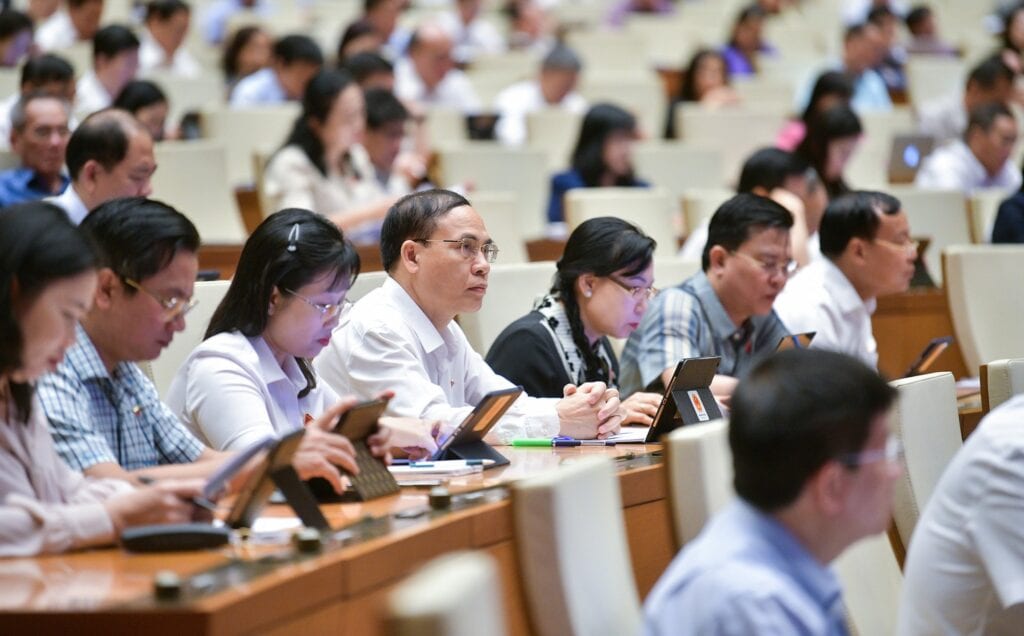
- Delegates debate the imposition of a 5% VAT tax on fertilizers.
On the afternoon of June 24th, the National Assembly discussed the draft Law on Value Added Tax (amended) in the plenary session. The issue that received significant attention and comments from delegates was the imposition of a 5% value added tax (VAT) on fertilizers.
With a 5% tax, farmers would have to spend approximately 6,000 billion VND.
Participating in the discussion, delegate Nguyen Danh Tu (from Kien Giang province) noted that removing difficulties and obstacles for the domestic fertilizer production industry is extremely necessary and that further consideration and research are needed on the possibility of shifting fertilizers to the 5% tax rate.
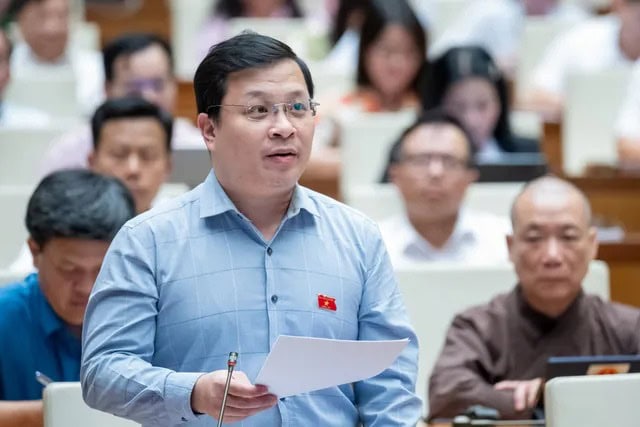
- Delegate Nguyen Danh Tu from Kien Giang province delivered a speech.
“Because fertilizers are one of the important inputs for agricultural production, essential goods that greatly affect socio-economic development, production and business, and people’s lives, especially farmers, they will be greatly impacted by this regulation,” Mr. Tu said.
Representative Tô Ái Vang (from Sóc Trăng province) stated that the long-standing conflict between agricultural product prices and fertilizer prices remains a pressing issue in Vietnamese agriculture. Therefore, she proposed that the National Assembly consider amending the Value Added Tax Law to include fertilizers under a 0% value added tax rate.
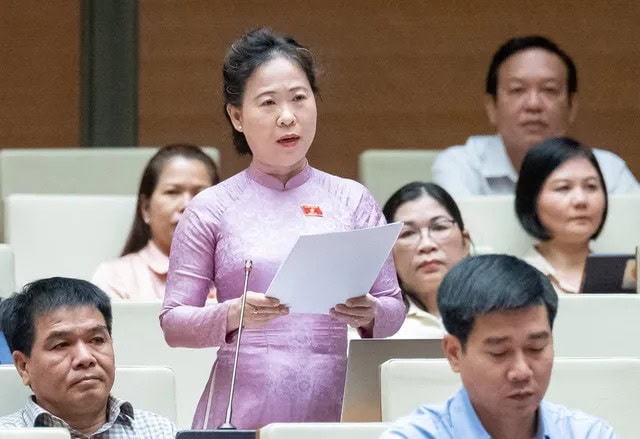
- Representative Tô Ái Vang (from Sóc Trăng province) speaks at the National Assembly.
Ms. Ai Vang explained that if the law maintains a 5% VAT rate on fertilizers, farmers would have to spend approximately 6,000 billion VND. However, if the draft law applies a 0% VAT rate to fertilizers, instead of adding 2,000 billion VND to the state budget, this money would be used to support businesses and farmers. This would significantly reduce farmers’ input costs.
The impact of taxing fertilizers needs to be assessed more carefully.
During the discussion, delegate Khang Thi Mao (Yen Bai delegation) suggested that the Government consider not applying the 5% tax rate to fertilizers.
In their reasoning, the delegates argued that the nature of value-added tax is an indirect tax with neutrality and high economic efficiency, as demonstrated in two aspects:
– Firstly, value-added tax (VAT) is not affected by the business results of the taxpayer; therefore, VAT is not a component of production costs, but simply an additional amount added to the selling price of the service provider.
– Secondly, value-added tax is not affected by the organization and division of the production and business process.
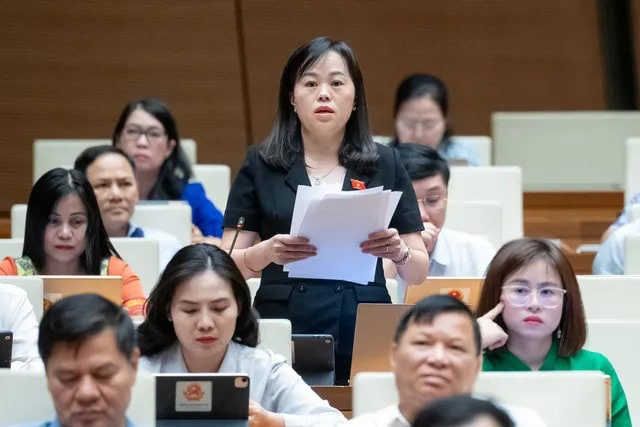
- Representative Khang Thi Mao (Yen Bai delegation) stated that a more thorough assessment is needed when taxing fertilizers.
Representatives from Yen Bai province argued that, according to the law, fertilizer prices are subject to price stabilization regulations. Therefore, it is necessary to ensure the principles of openness, transparency, and a balance of interests between organizations and individuals trading in goods and services and consumers.
Imposing a 5% tax does not create inequality.
In clarifying the issues raised by the delegates, Minister of Finance Ho Duc Phoc stated that there are differing opinions regarding fertilizer products, with some arguing that they should be tax-exempt, while others argue that they should be subject to a 5% tax. The Minister explained that during the period from the drafting of the Value Added Tax Law in 2008 to 2013 and 2014, fertilizers were initially included as taxable items subject to a 5% tax, but were later removed from the list of taxable items.
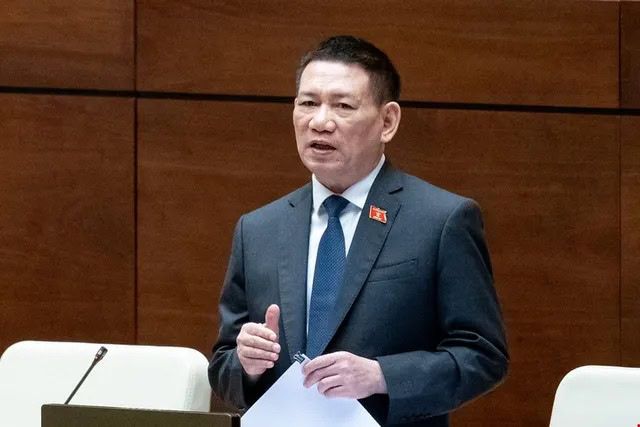
- Minister of Finance Ho Duc Phoc clarified several issues related to value-added tax (VAT) on fertilizers.
The Minister also informed that currently, domestic fertilizer production accounts for 73.3%, while imports account for 26.7%. The 5% tax rate will not create inequality between domestic and importing businesses. Furthermore, the value-added tax refund will provide resources for businesses to continue investing in technological innovation, reducing production costs, and achieving sustainable development.
According to Mr. Phuoc, fertilizer prices are affected not only by taxes but also by the supply and demand of goods; if the supply increases, prices will be lower, and conversely, if the supply is low, prices will be higher.
“We will seek the opinions of the associations and National Assembly representatives on this matter once again, and we will incorporate them at the end of the term,” the Minister of Finance said.
Source: Vietnam Television

Related news
Updated Fertilizer Prices on December 29, 2025 – Detailed Information for Farmers’ Reference
The National Assembly is considering imposing a 5% VAT on fertilizers
Vietnam Spends Nearly $682 Million on Fertilizer Imports
Early August: Fertilizer Prices Rise, Official Document Issued Regarding Rice Exports

Why Did the Global Fertilizer Market Continuously Face Difficulties in 2023?