
ACCOUNTING WITH FURTHER FARMERS
Diagnosis of Macro and Micronutrient Requirements of Plants
What are macro and micronutrients for plants?
Macronutrients and micronutrients are essential nutrients for plant growth and health. Macronutrients are nutrients that plants need in large quantities (hundreds of ppm to thousands of ppm), while micronutrients are nutrients that plants need in small quantities (a few ppm to tens of ppm). Below are some important macronutrients and micronutrients and their roles in plants:
If we liken plants to children, the macronutrients are protein, starch, and fiber, while the micronutrients are vitamins. This is because, although the required amount of these nutrients is very small, they are essential for plant growth.
In previous articles, Viet Nga Fertilizer has guided farmers on diagnosing the macronutrient needs of various crops. Today, we invite you to learn about the medium and micronutrient needs of crops through observable signs.
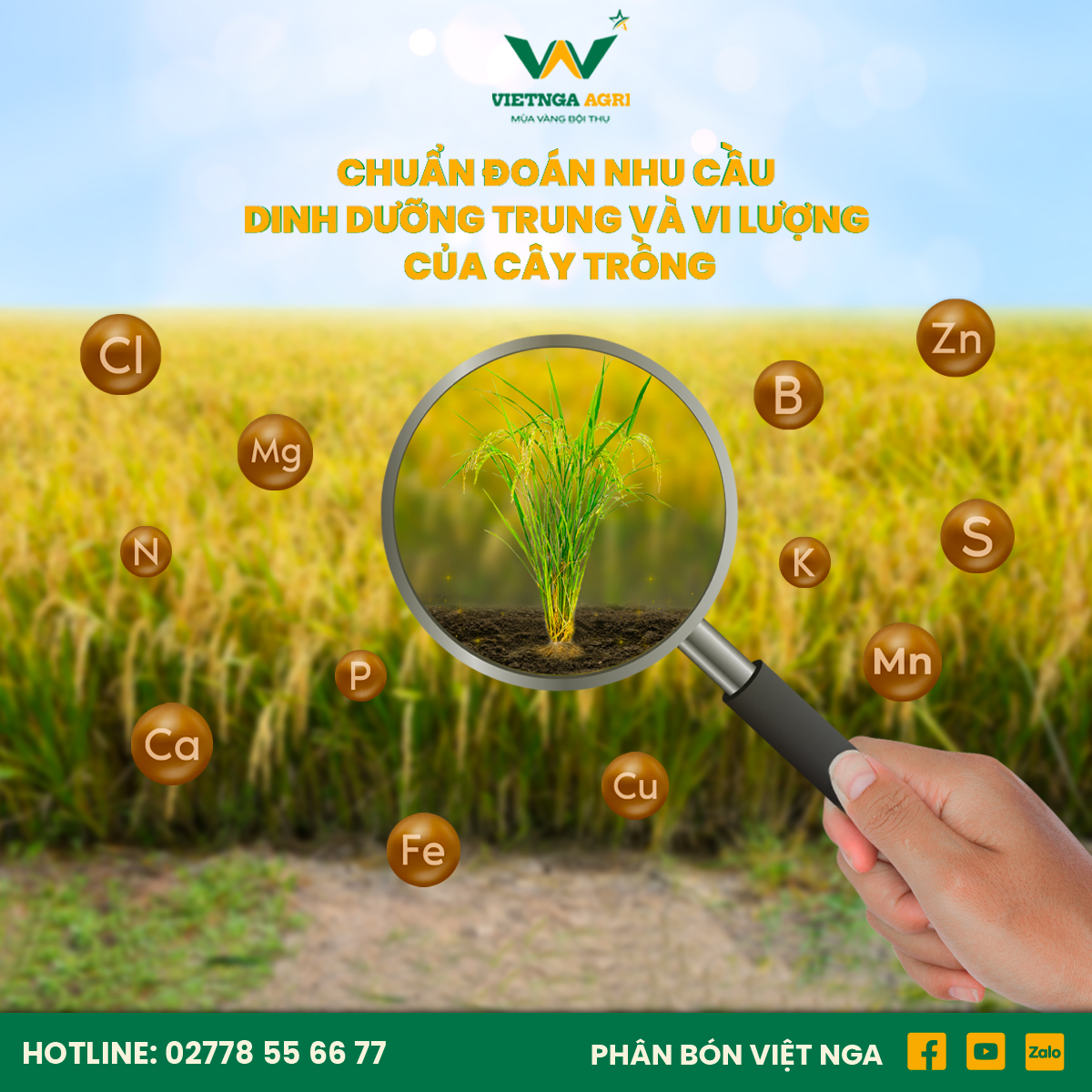
1. Symptoms of macro and micronutrient deficiencies in plants
– Calcium deficiency: Shoot tips wither and dry out, young shoots are underdeveloped, young leaves curl like a seashell, and some leaves wither and dry out. Buds and flowers fall off prematurely, fruits are deformed, and stems and branches are weak. Roots are underdeveloped, and plant growth is poor.
– Sulfur deficiency: Quite similar to nitrogen deficiency, young leaves turn pale green, and in severe cases, they turn yellow-orange. The plant is stunted, but the root system continues to develop normally. In severe cases, all the leaves turn yellow, and the plant dies.
– Magnesium deficiency: Characteristic symptoms include yellowish patches on the leaf blade between the veins, extending to the edges and tip, leaving a green, triangular area oriented towards the leaf apex. Leaves are curled and thinner than normal, fall off prematurely, and plant growth is poor.
– Manganese deficiency: Young leaves lose color in the veins and small dead spots appear. These yellow spots then dry out, sometimes tearing and perforating. The plant grows poorly and becomes stunted.
– Zinc deficiency: The young leaves are very small, the leaf blades are yellow, and the green veins are clearly visible. Internode growth is reduced.
– Copper deficiency: Typical symptoms include yellowing and slight curling of the leaves. Necrotic spots appear first at the tips of young leaves and then spread downwards along the leaf margins.
– Iron deficiency: Young leaves have a network of green veins visible on a pale yellow surface, and the leaf margins are slightly curled. This symptom persists until the leaves mature, leading to premature leaf drop, fewer flowers, and smaller fruits.
– Boron deficiency: Black spots appear on young leaves and apical buds; sometimes a portion of mature leaves wilt suddenly and dry out. Leaves curl slightly and become brittle. Severe deficiency causes the plant to produce many side shoots, and the root system is poorly developed and shortened. In tuber crops deficient in boron, the tubers are deformed or rot due to damage to the internal tissues.
– Chlorine deficiency: Plants turn yellow and wilt, similar to those affected by salinity.
2. Symptoms of excess macro and micronutrients in plants
– Excess calcium: This can easily cause symptoms of potassium, manganese, zinc, and iron deficiencies due to overly alkaline soil.
– Excess sulfur: Plant growth is poor, leaves are small and may turn yellow and burn.
– Excess magnesium: Older leaves show necrotic spots, and the small veins of these older leaves may turn brown.
– Excess Aluminum: Yellow and white streaks appear on older leaves, leaves dry out and wither, roots are poorly developed and curl. This often occurs in acidic soils.
– Copper Overgrowth: The plant is stunted, with dark green, slightly thick and curved leaves, poor branching, and underdeveloped roots. This often occurs due to the overuse of copper-based fungicides.
– Excess Iron: Also commonly seen in acidic soils, excess iron causes older leaves to turn copper-colored, making it difficult for the plant to absorb nutrients, leading to deficiencies in phosphorus, potassium, and zinc.
– Excess chlorine: Leaf tips and edges are burnt, leaves are small, and in some cases, leaves lose their color.
3. Solutions from Viet Nga Fertilizer
Currently at Viet Nga, in addition to imported fertilizers such as NPK 16-16-16+TE, NPK 20-5-25+TE, NPK 28-6-6+TE,… which are supplemented with macro and micronutrients such as Calcium, Iron, Boron, and Zinc, some fertilizers produced by Viet Nga also contain essential macro and micronutrients for plants.
– Viet Nga NPK 16-16-16+TE Fertilizer: Supplemented with Iron, Boron, and Zinc.
– Viet Nga Calcium Nitrate Fertilizer: Supplements Calcium and Boron.
– Viet Nga NPK 16-16-8-13S fertilizer: contains added sulfur.
– Viet Nga Medium-nutrient fertilizer: supplements Calcium and Magnesium.
Depending on the soil conditions, crops, and season, farmers can consider choosing the appropriate fertilizer based on the macro and micronutrients needed by their crops. We wish you efficient farming, a bountiful harvest, and good prices.

Related news

The Role of Base Fertilization in Soil Improvement and Enhancing Agricultural Fertility
Measures to Improve and Treat Saline Soil

Winter-Spring rice blast warning – Don’t let leaf and flower burns rob you of your golden crop

Rice Sowing Techniques for the Early Winter–Spring Crop

What Is Slow-Release Fertilizer? Learn How to Use It Effectively