
ACCOUNTING WITH FURTHER FARMERS
Detailed Guide: Proper and Environmentally Safe Handling of Rice Straw
Rice straw is a waste product in agriculture. Nowadays, burning rice straw causes environmental pollution and wastes nutrients beneficial to crops. Join Viet Nga Fertilizer in exploring proper rice straw disposal techniques in the article below.
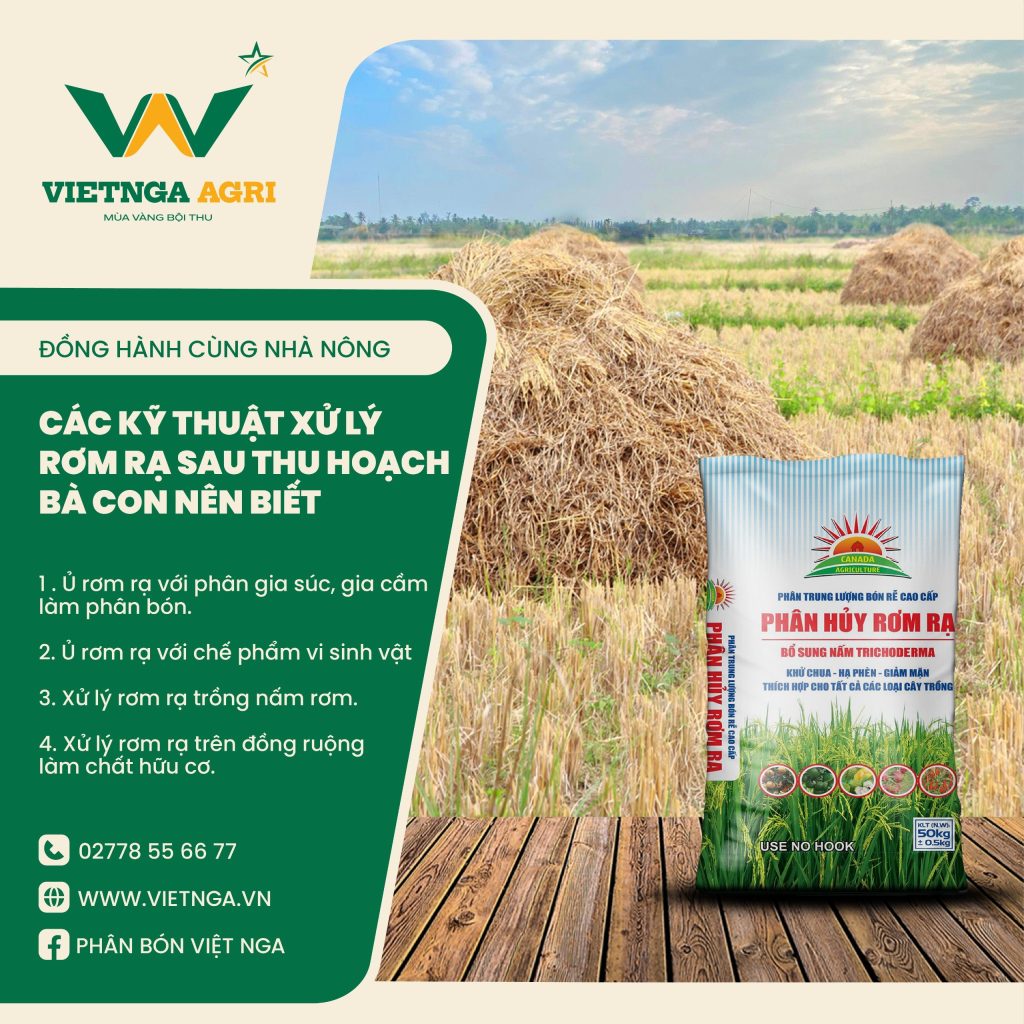
1. The harmful effects of burning straw.
– Environmental pollution: Harmful gases and toxic dust particles are released into the environment during the burning of straw.
– Impact on human health: Easily causes respiratory diseases and increases the risk of lung cancer when inhaling smoke, dust, and toxic gases.
– Causes imbalance in the agricultural ecosystem: Transforms organic matter into inorganic matter, water in the soil evaporates, and over time will cause soil degradation and compaction.
– Generates smoke and fine dust: Obscurs visibility and affects traffic.
– Waste of resources: Rice straw is a huge biomass source with great potential for use as fertilizer, mushroom growing material, animal feed, and as an input material for organic agricultural production.
2. Benefits of straw processing
– Reduces environmental pollution because burning straw does not produce toxic emissions.
– Creates natural and sustainable fertilizers for plants, improving soil quality.
– Increase crop yields and reduce the need for chemical fertilizers and pesticides.
– Saves costs and creates many economic benefits for farmers.
3. Some straw processing techniques that farmers should know.
3.1. Composting straw and animal manure to make fertilizer.
Composting straw directly in the field minimizes the cost and labor involved in transporting the straw. Alternatively, farmers can still implement this technique in warehouses or livestock sheds to utilize the available shelter; however, composting in warehouses requires a drainage system.
Procedure:
– 70% straw, 20% manure from livestock and poultry, and 10% other materials.
– Straw and other plant stems should be cut short and soaked in water overnight.
– Providing additional nutrients for microorganisms to metabolize straw, prepare molasses, urea fertilizer, and phosphate fertilizer.
– Mix all the molasses, urea, and phosphate solutions into 100 liters of water.
– Spread the prepared straw in a 15cm thick layer, then evenly cover it with the mixture of chopped green stems mixed with manure and animal waste. Spray or water with the prepared molasses, urea, and phosphorus solution, repeating this process until all the composting material is used up.
– Use tarpaulin or plastic sheeting to cover the compost pile. Check the moisture level of the straw daily during the composting process; if the straw is dry, add more water.
– After 15-20 days of composting, the compost pile should be turned over to speed up the composting process. It can be used after 1 month by spreading the composted straw evenly in the field before tilling the soil.
3.2. Composting rice straw with microbial preparations.
This technique is similar to the one described above and can be implemented directly in the field or at a suitable location.
Procedure:
– Spread a 15 cm thick layer of treated, chopped straw soaked in lime water. Spray or water with a mixture of molasses solution, urea, and microbial preparation at a dosage equal to 10% of the total amount of straw spread in the layer.
– Cover the compost pile with tarpaulin or plastic sheeting. After 7 and 21 days of composting, turn the pile over to create optimal conditions for microorganisms to convert organic matter.
– After 28-30 days of composting, the straw can be used when it turns brown, becomes loose and fluffy, is odorless, and can be used as a source of organic fertilizer for crops.
3.3. Processing straw for mushroom cultivation.
Utilizing rice straw to cultivate straw mushrooms solves the problem of rice straw waste and provides farmers with additional income by creating new work opportunities.
Procedure:
– After harvesting, the straw is soaked in lime water or poured directly onto the compost pile. The lime water is mixed at a ratio of 3 kg of lime to 100 liters of water.
– When the straw softens, turns yellow, and has a strong lime smell, remove it and let it drain. The moisture content of the straw before composting should be 70-75%.
– The straw composting area must be clean, dry, and free from standing water during heavy rain. The straw is piled up on a raised platform, covered with a plastic tarp, and securely tied with plastic rope.
– The composting time is 9-12 days, and after piling, the straw is turned over after 3-4 days. Straw suitable for mushroom cultivation must meet the following requirements: it should be completely soft, have a bright yellow color, and possess the characteristic aroma of fermented straw.
3.4. Processing rice straw in the fields to produce organic matter.
This technique offers many benefits to farmers, both protecting the environment and saving production costs thanks to the reuse of organic fertilizer.
Procedure:
– After harvesting the rice, let the straw soak in water for 1-2 days, then drain the water and spread lime on the field surface.
– Mix the Trichoderma preparation with water and spray evenly, ensuring that all the straw and stubble are completely buried in the soil.
– Fill the field with water and let it soak for about a week, then plow and level the surface, and drain the water to dry the field.
– A new farming season can begin after leaving the fields fallow for 5-7 days.
Treating rice straw with microbial preparations is considered a simple and easy method, requiring a short processing time, allowing for a quick start to the new planting season, reducing fertilizer costs, and increasing productivity and profitability. In addition, it reduces the burning of rice straw after harvest, thus protecting the environment.
Viet Nga medium-nutrient fertilizer decomposes straw, reduces soil acidity, and detoxifies organic matter.
With the addition of Trichoderma, Azotobacter, and Bacillus fungi, this technology helps decompose rice straw quickly and efficiently right in the field, while also neutralizing acidity, reducing alkalinity, increasing soil fertility, and promoting strong root development, sturdy plants, and healthy sprouting and branching. Furthermore, it can treat organic poisoning, nourish healthy plants, and enhance beneficial microorganisms for plant growth.
Dear customers, you can contact Viet Nga Fertilizer via hotline 02278556677 to learn more about the product and how to use it for best results.
Conclusion
Each processing technique is tailored to the specific conditions of individual farmers and localities. Applying the techniques shared above helps increase the value of rice straw.
To learn more about other farming techniques, please refer to the “Accompanying Farmers” section, which provides farming knowledge, techniques, and information on how to deal with the effects of weather. We wish you a bountiful harvest in the new farming season!
Related news
Caring for the Winter-Spring Rice Crop to Ensure Large, Firm Grains

Secrets to Helping Rice Plants Stay Healthy Right From the Start of the Winter-Spring Crop Season
Proper Water Management for Winter-Spring Rice Crops

Tips for Effective Fertilization of the Winter-Spring Rice Crop

What kind of fertilizer should I use to make my banana tree flower and produce large fruits?