Asia’s Fertilizer Market “Out of Sync”: Crop Prices Fail to Keep Pace with Rising Costs
The ongoing conflict in the Middle East has pushed fertilizer prices sharply higher across Asia since late February. However, this rise in input costs has not yet been matched by a corresponding increase in prices of key agricultural commodities, creating risks to farmers’ profitability and potentially delaying planting decisions for the upcoming crop season. Follow Viet Nga Agri to explore the latest fertilizer market developments and their impact on agricultural production in the current period.
Asia’s Fertilizer Market Is Showing an “Out-of-Sync” Supply–Demand Imbalance
The “out-of-sync” gap between soaring fertilizer prices and a sluggish agricultural commodity market reflects a lag in the agricultural production cycle. According to analysts, this may reduce surplus export volumes and push food prices higher in the coming period, as farmers are forced either to absorb higher costs or reduce planting acreage.
Since late February, disruptions around the Strait of Hormuz have driven sharp increases in nitrogen and phosphate fertilizer prices worldwide. Among them, nitrogen fertilizers have recorded the most significant gains. Specifically, according to Platts, Middle East FOB urea prices reached USD 604–710 per ton. On 19 March, this marked a sharp increase from USD 436–494 per ton on 26 February, before the conflict began. In Southeast Asia, prices urea reached USD 750 per ton. FOB on 19 March, up from the previous range of USD 490–498 per ton. Although prices remain under upward pressure, the current price level is still below the 2022 peak, but has risen significantly above the average recorded in 2023.
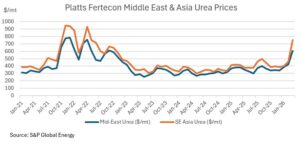
The phosphate market is also experiencing a similar tightening trend. According to Platts, DAP CFR Thailand prices have risen to USD 850 per ton. on 19 March, compared with the previous level of USD 764–766 per ton, as importers accelerated purchases to secure supply. This upward momentum was mainly driven by rising Middle East sulfur prices—an important input raw material— up by nearly USD 200 per ton.
This price shock is a direct result of severe transportation disruptions, which have tightened the supply–demand balance and created clear upward pressure on the prices of key products such as ammonia, urea, and ammonium phosphate fertilizers. Notably, it has also affected raw materials across the value chain, including natural gas and sulfur.
In addition, China—one of the region’s largest producers of urea and phosphate fertilizers—continues to restrict exports under strict quota control policies, preventing an important source of supply from helping stabilize an already tight global market.
Amid supply disruptions, available offers for major fertilizer products are becoming increasingly limited, while ready cargoes are often quoted at higher prices. Although bid prices have risen in an effort to secure scarce supply, cautious sentiment continues to dominate the market, leading some importers to delay transactions and wait for clearer signs of price stabilization in the coming period.
Agricultural Commodity Prices Have Yet to Keep Pace with Rising Input Costs
Although input costs have risen sharply, the impact on agricultural commodity markets has not been uniform. This is most evident in the rice sector, where spot prices tracked by Platts have declined continuously since September 2025 due to abundant global supply. The average price of 5% broken long-grain white rice FOB India reached USD 343.95 per ton in February 2026, down nearly USD 54 per ton (equivalent to 13.5%) compared with the same period last year, according to Platts data, and continued to decline by around USD 11 per ton to USD 333 per ton on 19 March.
Conversely, the price of 5% broken long-grain parboiled rice CFR West Africa, as assessed by Platts, increased by only around USD 20 per ton to USD 408 per ton since 19 February, with the rise mainly driven by higher freight costs.
In the wheat market, buyers in Thailand have seen delivered feed wheat prices rise by 5%–13% (equivalent to USD 15–34 per ton) since 28 February, according to Platts tender data. More notably, however, is the delivery timing of these transactions: many cargoes have been booked for shipment as late as February 2027, which several market sources consider unusual for purchases made so far in advance.
Meanwhile, in Australia—one of the region’s key exporters of milling wheat—FOB Australian APW wheat prices increased by only USD 4 per ton since 27 February, reaching USD 263 per ton on 18 March, reflecting weak demand. “For Australia, the short-term outlook for wheat remains relatively stable, as many input requirements had already been purchased in advance,” said Zinkovski Vladimir, Head of Agriculture at S&P Global Energy CERA. However, he also warned that “prolonged inflation in fertilizers and energy—combined with rising El Niño risks—could reduce yields and shrink surplus export volumes, while the current high price environment may also lead to a decline in demand.”
Lagged Impact
Fertilizer price shocks are not immediately reflected in agricultural commodity markets due to the inherent time lag in the agricultural production cycle. This means that the impact of rising prices will be felt most strongly by those preparing to purchase inputs for upcoming planting seasons, as higher fertilizer costs may lead to lower yields and ultimately result in higher agricultural commodity prices.
In India, fertilizer supply is currently assessed to be relatively stable, and supportive policies such as Minimum Support Prices (MSP) and urea subsidies are helping to maintain farmers’ production incentives for the upcoming season. “With this in place, the likelihood of a significant reduction in kharif rice acreage (the summer-autumn crop season in Vietnam) is low,” said Ms. Dipanshi Agarwal, Lead Agricultural Analyst for Asia–Pacific at CERA.

However, this protection also carries risks. Indian farmers continue to purchase urea at fixed prices, shielding them from global price volatility, but there is a risk of lower yields if farmers become overly dependent on nitrogen fertilizers.
“India’s dependence on imports of diammonium phosphate (DAP), muriate of potash (MOP), and compound fertilizers remains a structural vulnerability,” Ms. Agarwal said. “Any increase in global prices or supply disruptions could push farmers toward subsidized urea, leading to nutrient imbalance and increasing the risk of lower yields.”
Mr. Alberto Persona, Director of Fertilizer Analysis and Sustainability at S&P Global Energy, added that agricultural subsidy and support programs have been significantly expanded in many countries following recent global shocks, including the COVID-19 pandemic and the Russia–Ukraine conflict.
Although these policies provide some level of support, the ultimate pressure is still passed down the chain. “Prolonged high prices will inevitably be transmitted to consumers at downstream stages of the value chain,” Mr. Persona noted, while also pointing out that “current price increases do not necessarily translate into proportional rises in agricultural production costs, as farmers may adjust their fertilizer application levels accordingly.”
“Overall, the situation remains concerning, but it is also important not to exaggerate the scale, immediacy, or duration of its impact on everyone’s livelihoods—although some opinions may suggest otherwise,” Mr. Persona said.
Amid continued volatility in the Asian and global fertilizer markets, along with persistently high input costs, proactively monitoring market information and selecting appropriate nutrient solutions will play a key role in ensuring farming efficiency for each crop season. With many years of experience in fertilizer distribution, manufacturing, and importation, Viet Nga Agri is always ready to accompany valued dealers and farmers in updating market developments, providing guidance on appropriate fertilizer use solutions, and contributing to cost optimization and stable crop productivity.


Related news
Asia’s Fertilizer Market “Out of Sync”: Crop Prices Fail to Keep Pace with Rising Costs
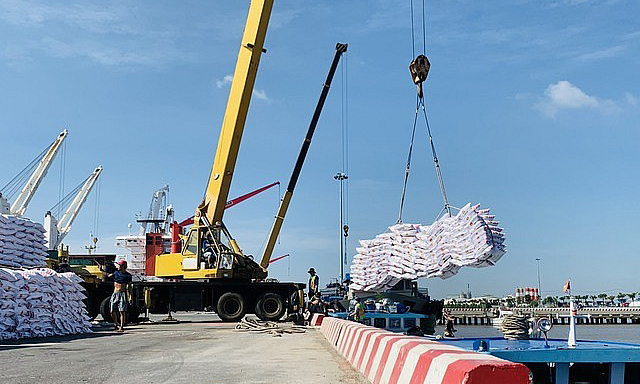
Middle East Conflict Drives Fertilizer Prices Higher, Supply Faces Risk of Disruption

Widespread Heavy Rain in Southern Vietnam – Farmers Need to Take Proactive Measures to Protect Their Crops
In 10 Months, Vietnam’s Cashew Industry Completed Its Export Plan
China Purchased 1.5 Million Tons of Durian in 10 Months