The Carbon Credit Market in Vietnam is Receiving Encouraging Signs
Currently, the carbon credit trading price list is divided into 3 main groups (according to Golden Standard):
– Planting and protecting forest resources at a price of $9.77 per credit unit.
– Utilize renewable energy (solar panels, wind turbines, etc.) at a price of $9.67 per credit unit.
– Use resources (land, water, etc.) efficiently with a selling price of USD 14.87 per credit unit.
2023 can be considered a booming year for the carbon credit market in Vietnam, with a series of positive developments. As a promising “commodity” with the potential to generate $250 million in revenue annually, the carbon credit market, if developed smoothly, will improve the income of Vietnamese people, especially farmers.

1. Vietnam earns its first $41 million from selling forest carbon credits.
The ERPA is an agreement on the transfer of Carbon Credits for the period 2018-2024 between the provinces of Thanh Hoa, Nghe An, Ha Tinh, Quang Binh, Quang Tri, and Thua Thien Hue and the World Bank (WB), represented by the Ministry of Agriculture and Rural Development. By transferring 10.3 million tons of CO2 to the WB at a price of US$5/ton, Vietnam earned US$51.5 million. To date, Vietnam has received over US$41 million, equivalent to 80% of the total funding.
In addition, the upcoming agreement on forest carbon transfer between Emergent/LEAF and the Central Highlands and South Central provinces, with the support of the Vietnamese Ministry of Agriculture and Rural Development, is also expected to become another successful carbon credit project for Vietnam. It is estimated that this transaction will bring in approximately $51 million.
2. Potential $100 million from rice-specialized farming areas thanks to credit sales.
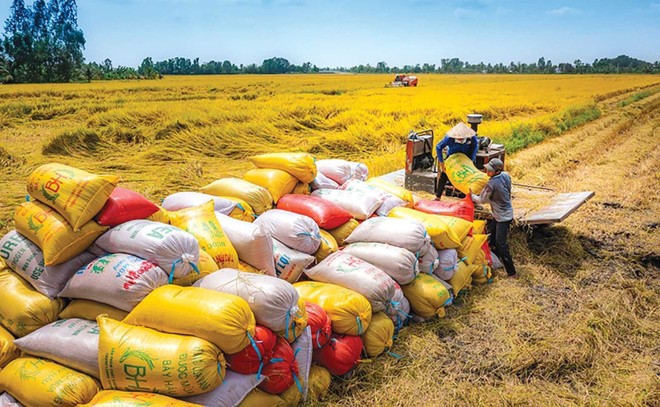
It’s not just areas planted with perennial industrial crops or forests that can store carbon. The World Bank estimates that if Vietnam’s largest rice granary – the Mekong Delta – were to develop specialized high-quality rice farming zones, it could store 10 million tons of carbon, generating approximately $100 million in revenue.
Dong Thap province alone has registered to strive to achieve a cultivated area of 70,000 hectares for high-quality rice by 2025 and 163,000 hectares by 2030.
According to the Ministry of Agriculture and Rural Development, through agreements with the World Bank, carbon credit payments will take place in 2024 for rice-growing areas implementing the VnSAT program, ensuring reduced greenhouse gas emissions (1 must, 5 reductions; 3 reductions, 3 increases + mid-season water drainage).
When the trading process goes smoothly, in addition to the revenue achieved, Vietnam also aims to improve the quality of rice grains and fulfill the commitment signed with the International Rice Research Institute (IRRI) to reduce global methane (CH4) emissions. According to the commitment, by 2030, Vietnam aims to reduce total CH4 emissions by 30% – a gas that is particularly abundant from agriculture, especially rice cultivation.

3. The first Carbon Credit Exchange in Vietnam
On September 29th, the ASEAN Carbon Credit Exchange Joint Stock Company was officially launched. This exchange is expected to provide information and advice to businesses, organizations, and individuals in Vietnam on how to build carbon credit projects, how to register, verify, and certify them, as well as mechanisms for exchange, compensation, and credit financing for carbon credits, and the application of carbon taxes in the region and globally.
Stemming from the reality of price manipulation and the lack of transparency in carbon credit trading, the establishment of an automated trading platform will address these issues. With serious investment from the government and individuals, this is the first step in creating a mutually beneficial relationship, bringing many advantages to both buyers and sellers of carbon credits. As a result, the value of carbon credits in Vietnam is expected to grow in the near future.
Sources: Tuoi Tre Newspaper, Dan Viet Newspaper, Thanh Nien Newspaper.

Related news
Asia’s Fertilizer Market “Out of Sync”: Crop Prices Fail to Keep Pace with Rising Costs
Middle East Conflict Drives Fertilizer Prices Higher, Supply Faces Risk of Disruption
Widespread Heavy Rain in Southern Vietnam – Farmers Need to Take Proactive Measures to Protect Their Crops
In 10 Months, Vietnam’s Cashew Industry Completed Its Export Plan
China Purchased 1.5 Million Tons of Durian in 10 Months