Growing Techniques and Specialized Fertilizers for Heavy-Fruiting Mango Trees
Date
Contents· 5 sectionsExpandCollapse
Today, the value of mangoes keeps rising and contributes significantly to the agricultural GDP of the Mekong Delta in particular and Vietnam in general. The following article will help farmers learn more about care techniques and Viet Nga Fertilizer’s specialized fertilizers for mango trees that help mango trees grow well and achieve high yields.
1. Benefits of mangoes
1.1. Health benefits of mangoes
Did you know that one green mango provides as much vitamin C as 35 apples, 18 bananas, 9 lemons and 3 oranges, according to Boldsky. That is why mangoes have many positive effects on human health, such as detoxifying the liver, boosting immunity and reducing acid reflux,…
1.2. Benefits of mangoes for Vietnam’s economy
The total mango-growing area nationwide is over 114,000 ha, of which the Mekong Delta accounts for nearly half. In 2021, Vietnam’s mango export turnover exceeded USD 180 million, accounting for just over 1% of total global mango exports. Dong Thap Province alone produces about 567,000 tons a year and contributes greatly to the country’s mango exports.
2. Mango tree care techniques
2.1. Suitable environmental conditions for mango trees
Mango is a crop suited to tropical climates, requiring temperatures of 24–26°C and a dry season for flower bud differentiation.
Although mango can be grown on many soil types, it does best on sandy or sandy loam soil, as this soil drains well and has a soil layer at least 1.5 m deep. In low-lying areas, raised beds at least 1 m high at the base must be built before planting.
2.2. Choosing mango varieties
Mangoes are propagated by many methods such as seeding, air layering and grafting,… but the most common is branch grafting. When planting, choose healthy, disease-free seedlings with the graft point 15–20 cm above the base and a plant height of 50–70 cm measured from the top of the nursery bag.
According to a survey by the Southern Fruit Research Institute, Vietnam has about 100 mango varieties. The most popular are the following:
– Cat Hoa Loc mango: Widely grown in Dong Thap, Tien Giang and other Mekong Delta provinces. The fruit is sweet and very fragrant when ripe, with a small seed, thick flesh and high economic value.
– Cat Chu mango: Widely grown in Dong Thap, Tien Giang and other Mekong Delta provinces. When ripe, the skin turns an attractive yellow, and the flesh is fragrant, richly sweet and fiberless.
– Taiwan mango: Commonly grown in the Southeast region. The fruit is fairly large with a small, long seed. When ripe, it tastes richly sweet. Notably, it is sweet even when eaten green.
2.3. Care
– Mulching around the base with decomposed straw or dry grass limits weeds and reduces water evaporation.
– While the trees are young, watering can be done year-round to supply enough water for new flushes to form and develop. Once the trees are mature, they need a dry period of about 2 months before flower bud differentiation. Therefore, do not water mangoes at the end of the rainy season and the beginning of the dry season.
– Fertilizing: Using fertilizer is the simplest way to promptly supply the nutrients the tree needs for growth at each stage.
3. Fertilization techniques for mango trees
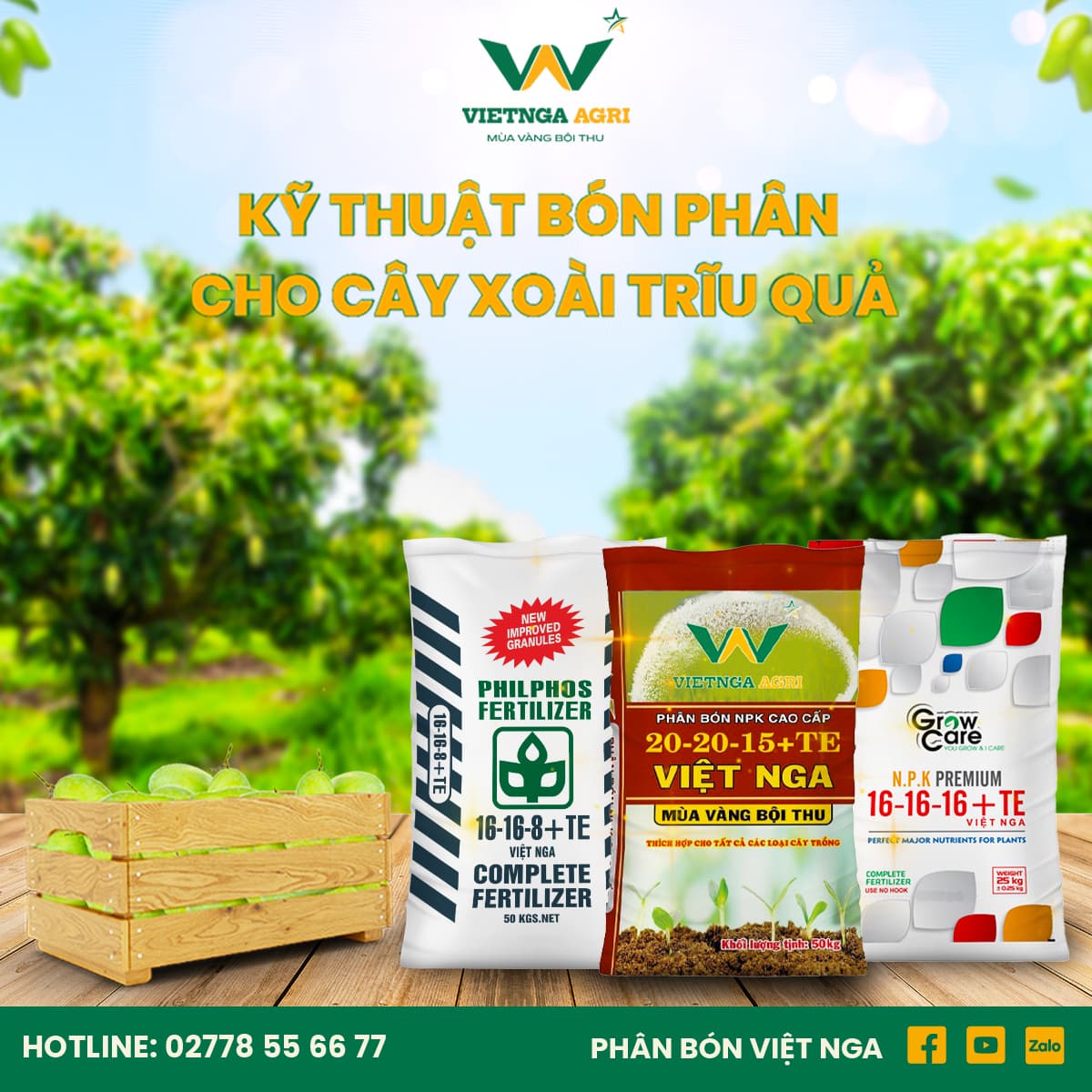
– Young tree stage: During the first 5 years, mango trees do not need much fertilizer. At this stage, young trees need adequate N, P and K so that new shoots emerge continuously, forming a large canopy that helps the tree grow quickly and bear fruit early. Apply 200–300 g/tree per application of Viet Nga NPK 16-16-8+TE every 6 months. In the first year, dissolve the fertilizer in water and pour it around the base so the tree can absorb it easily.
– Fruit-bearing stage: About 2 weeks before bud induction, apply Viet Nga NPK 20-20-15 or Viet Nga NPK 16-16-16 at a rate of 700–1000 g/tree.
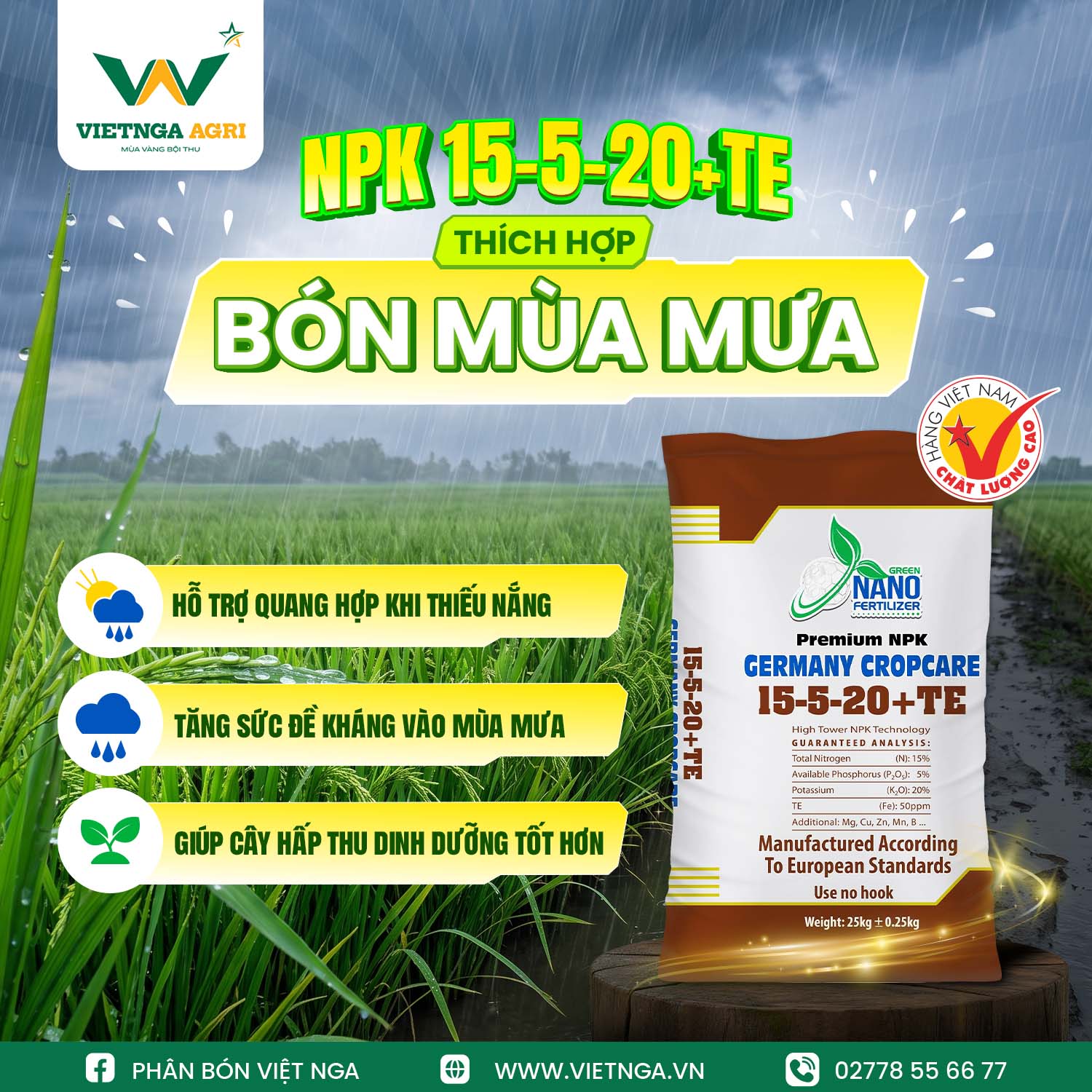
– Young fruit set stage: apply NPK Lon Trai 15-5-20 at 700–1000 g/tree to improve fruit set and reduce young fruit drop.
– Fruit bagging stage: apply NPK Lon Trai 15-5-20 at 700–1000 g/tree to prevent fruit cracking and increase fruit size.
– Pre-harvest stage: apply NPK Lon Trai 15-5-20 at 800–1000 g/tree to help fruit ripen evenly, improve fruit quality (color, sweetness, aroma,…) and increase fruit weight.
– After harvest: apply NPK Da Nang 17-17-17 at a rate of 500–700 g/tree to help the tree recover vigorously for the next crop.
4. Notes when fertilizing mango trees
When fertilizing mango trees, keep the following in mind to achieve the best results:
– If the tree produces many glossy leaves, it has excess nitrogen.
– Before flowering, spray foliar fertilizers or micronutrient fertilizers to ensure the mango has all the essential nutrients and to stimulate abundant flowering and fruit set.
– Fruit cracking may be caused by excess potassium or calcium deficiency. In this case, apply lime, spray Na(NO3)2 or apply CaSO4.
– Dig a trench around the canopy at a diameter of 1–2 m from the trunk and 15–30 cm deep, place the fertilizer and cover with soil, or apply in 6–8 holes around the trunk so the tree absorbs the fertilizer best.
5. Post-harvest tree care
After harvest, fruit trees in general and mango trees in particular need time to recover. During this period, farmers should prune branches to shape the canopy and improve airflow. At the same time, cut off pest- and disease-infected branches to prevent the spread of disease from one branch to another. Then clean up the orchard and remove weeds around the base of the tree.
Above is a guide to care techniques and how to use Viet Nga fertilizers for mango trees to achieve a heavy-fruiting mango crop. We wish farmers a bountiful harvest and good prices!
Popular search keywords: How and when to fertilize mango trees, NPK ratio for fertilizing mango trees, Fertilizing mangoes after harvest, How to fertilize mango trees, Top-dressing schedule for mango trees, Potassium fertilizer for mangoes, fertilizer for mango trees, NPK fertilizer for mango trees, Mango growing process, fertilizer for fruit trees