Off-Season Mango Flower Induction Techniques: A Bumper Crop at Good Prices Within Reach
Date
A bumper harvest with collapsing prices has long been a sad story in our country’s agriculture. In particular, the fluctuating prices of farm inputs, especially fertilizer, have recently put farmers at risk of losses. This has led farmers to look for new directions for their produce.
Among these, inducing trees to flower off-season (counter-season) to reduce price competition is one of the most useful methods, delivering more sustainable results than converting farmland to other crops or holding produce back in hopes of higher prices.
As one of the country’s key crops, mango is grown on a fairly large area (approximately 100,000 ha). So today, let’s join Viet Nga Fertilizer to learn the technique of inducing off-season flowering in mango trees, putting a bumper crop at good prices within your reach.
1. Factors Affecting Mango Flowering
1.1. Temperature:
Low temperatures stimulate flower bud formation and cause the tree to bloom. Night temperatures of about 18 – 20°C favor mango flowering. In the Mekong Delta, the end of the year brings suitable temperatures that stimulate flowering, so the main mango season usually falls in April or May.
1.2. Drought:
After a period of drought, the tree is “shocked” into flowering. This method is also known as “water withholding” and is used to induce off-season flowering. It is carried out as follows:
– Step 1: Prune branches inside the canopy and diseased or pest-damaged branches to open up the canopy.
– Step 2: Clear weeds from around the base of the tree.
– Step 3: Remove weeds and plant debris from around the base and under the canopy to dry the soil beneath the canopy.
– Step 4: Expose the soil to the sun to reduce moisture.
– Step 5: Cover the entire soil area around the base, following the drip line of the canopy, with plastic sheeting to keep rainwater from soaking in.
1.3. Variety:
Unlike the Thom, Cat Chu and Thanh Ca varieties, the Cat Hoa Loc mango is relatively difficult to induce to flower.
1.4. Branch age:
Stimulating young branches makes the mango put out new flushes, while old branches (more than 10 months old) are hard to induce to flower. Research by the Ministry of Agriculture and Rural Development shows that branches 1.5 – 2 months old are the easiest to induce to flower.
1.5. Growth condition and yield of the tree:
Trees that grow vigorously and bore heavily in the previous season are easy to induce to flower in the next season but are prone to exhaustion. Trees that bore little fruit the previous year or are putting on vigorous stem and leaf growth are very difficult to induce to flower.
2. Techniques for Inducing Off-Season Flowering in Mango Trees
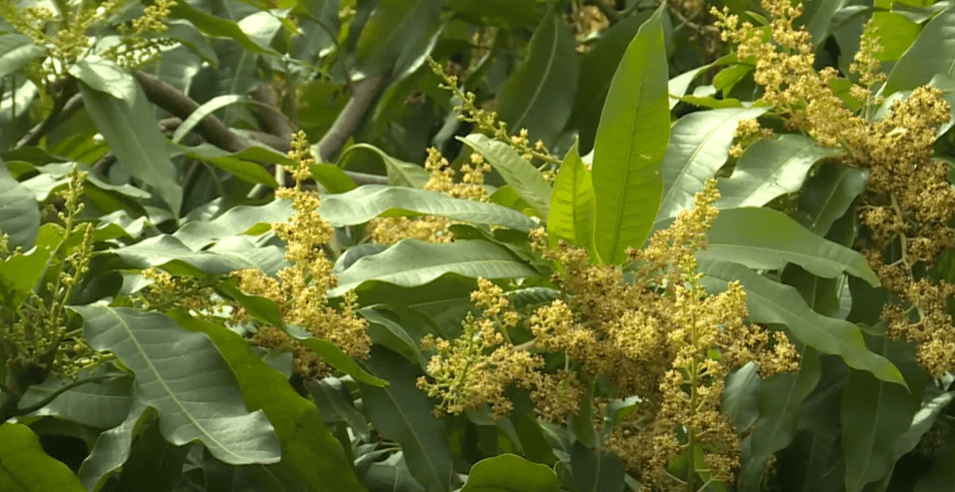
Balanced use of fertilizers and chemicals helps ensure effective off-season flower induction.
2.1. Post-harvest stage
– Pruning: thin out weak, diseased or pest-damaged and overlapping branches so the tree flushes uniformly, setting the stage for uniform flowering.
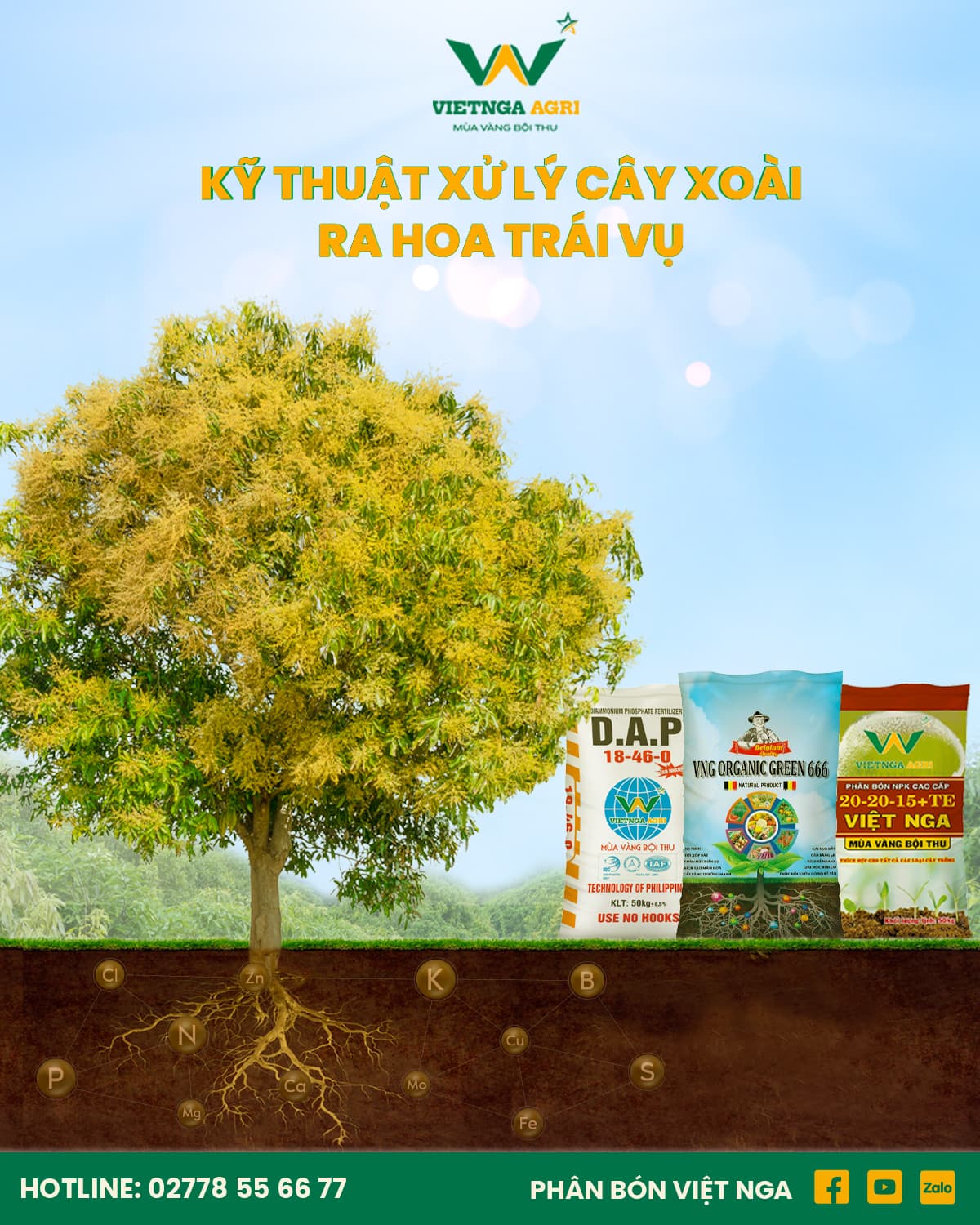
– Fertilizing: Use VNG Organic Green 666 organic fertilizer or Nauy Gronn organic fertilizer combined with Viet Nga NPK 20-20-15+TE at a 1:1 ratio, applying 1.5 – 2.0 kg/tree depending on tree age. After fertilizing, water every 2 – 3 days to help the fertilizer soak in and the roots absorb nutrients well.
2.2. Young flush stage
This flush is critical in determining flowering, so in addition to controlling pests and diseases to protect the young shoots, the flower induction procedure must be followed correctly.
– Step 1: Using a mix of 1 – 2 g of the active ingredient Paclobutrazol in 3 – 5 liters of water, begin drenching when the young leaves are 10 – 15 days old (fully expanded, coppery red). For the following 7 days, water regularly every 1 – 2 days.
– Step 2: 25 – 30 days after the Paclobutrazol treatment, apply Viet Nga DAP 18-46 and Viet Nga Potassium Chloride 61 at a 1:1 ratio, at 300 – 500 g/tree.
– Step 3: 45 – 60 days after the Paclobutrazol treatment, spray KNO3 to stimulate flowering. Spray on rain-free days when the terminal buds are swelling strongly and protruding and the leaf veins have curved. Spray a second time 5 – 7 days later at a 50% reduced rate.
2.3. Off-season flowering stage
– Top-dress to support flower development with Viet Nga NPK 16-16-16+TE or NPK 17-17-17 at 200 – 300 g/tree.
– Spray boron-containing fruit-set enhancers such as Viet Nga Calcium Nitrate twice (when the panicles are about 10 cm long and when about 15% of the flowers on the panicle have opened).
For the stages after fruit set, please care for and fertilize your mango trees following the guidance in the article Care and Fertilization Techniques for Heavily Fruiting Mango Trees. We wish you productive farming, a bumper crop and good prices.
Source: Dong Thap Provincial Agricultural and Fisheries Extension Center