ACCOUNTING WITH FURTHER FARMERS
Do farmers truly understand Sustainable Rice Production (SRP)?
Sustainable rice production is becoming an important trend not only in Vietnam but worldwide. The Sustainable Rice Platform (SRP) standard is considered an essential guide for farmers to improve their farming methods, protect the environment, and increase their income. Let’s explore what SRP is with Viet Nga Fertilizer in the following article!
1. What is Sustainable Rice Production (SRP)?
Sustainable Rice Production (SRP) is a forum for sustainable rice production, a global multi-partner alliance convened in 2011 by UNEP and IRRI, involving 29 related organizations. The SRP model promotes efficient resource use and resilience within the rice system – in the field and along the value chain – while strengthening income for smallholder farmers.
- The SRP model promotes resource efficiency and resilience.
SRP promotes resource efficiency and resilience to the impacts of climate change in rice production systems on the farm and in the value chain, and pursues voluntary market transformation initiatives by developing sustainable production standards, indicators, incentives, and community outreach mechanisms.
2. What is the Sustainable Rice Production Standard (SRP)?
In 2015, SRP developed the SRP standards with the goal of minimizing the environmental impact of rice production and consumption while increasing income for smallholder farmers and contributing to food security.
The SRP standard comprises 41 evaluation criteria across 8 related areas of rice production, as shown below:

- Sustainable rice production standards
Overall, these requirements encompass the social, economic, and environmental aspects that constitute the concept of “sustainability” in general.
Refer to the Sustainable Rice Production (SRP) document here.
3. The application of SRP in Vietnam
3.1. Methods of applying SRP in Vietnam
When applied in Vietnam, the SRP criteria will guide rice farmers towards reducing the amount of seeds sown, reducing the amount of pesticides and fungicides, and reducing the amount of nitrogen fertilizer; increasing rice yield, improving rice quality, and increasing economic efficiency (also known as the “3 reductions, 3 increases”).
 |
 |
The principle of 3 increases and 3 decreases in rice cultivation.
In addition, farmers Certified seeds must be used for commercial rice production; costs for seeds, fertilizers, pesticides, irrigation, harvesting, and post-harvest losses need to be reduced. to increase profits, (also known as “1 must, 5 reductions”).
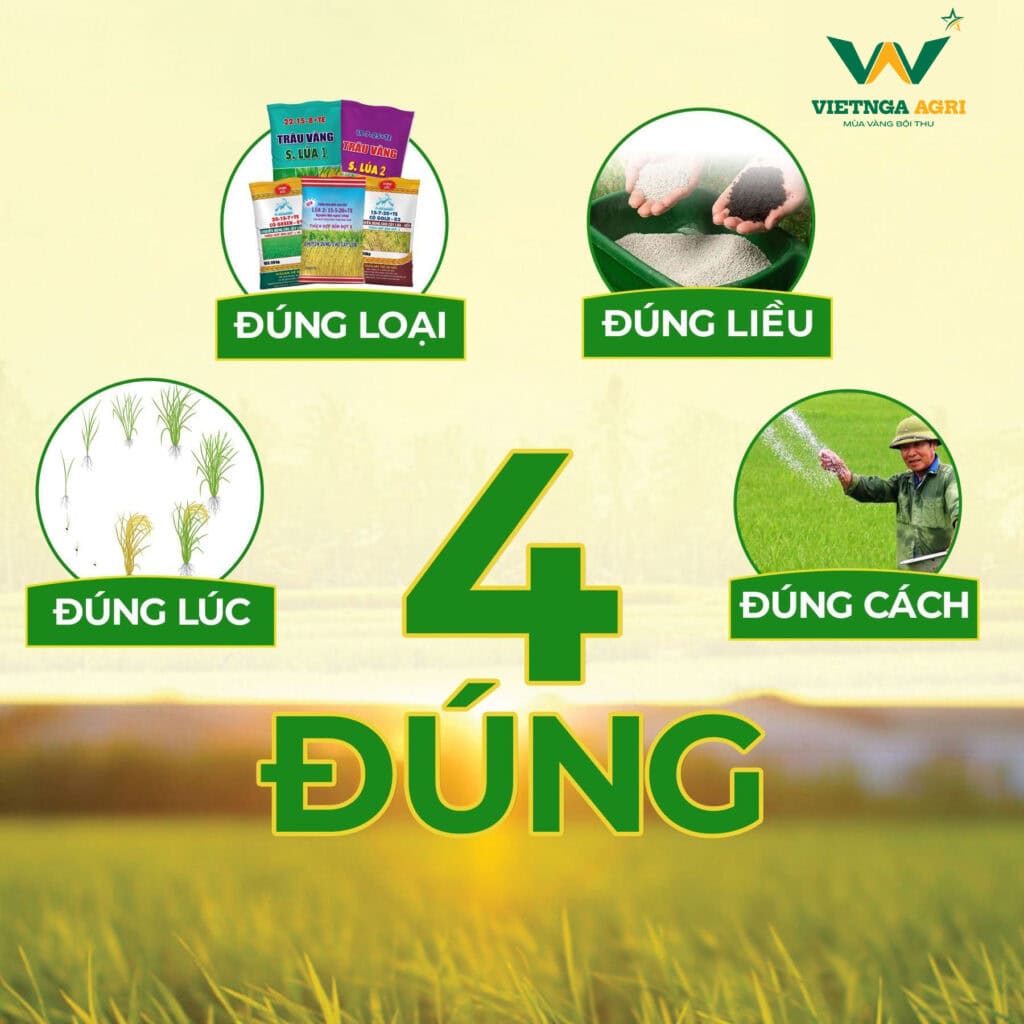
- The four correct principles in agricultural production.
After harvesting, farmers should not burn straw, and when fertilizing, they should combine inorganic and organic fertilizers. Integrated pest management should be implemented according to the principle of using the right pesticide at the right time, at the right dosage/concentration, and in the right way (also known as the “four correct” principles).
Two commonly implemented farming methods to meet these requirements are the alternating wet-dry irrigation (AWD) technique and precision sowing (DSR) mechanized planting.
Specifically, farmers applying the alternating wet and dry irrigation technique will fill the field with water to a level of 3-5 cm and allow this water to drain naturally until the surface of the field shows slight cracks, then refill the field with water, and continue to allow the field to dry and crack again.
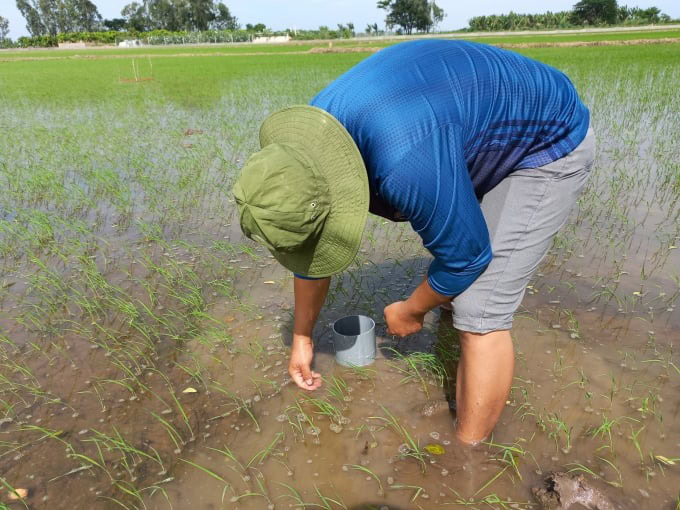
- Alternating wet and dry irrigation technique
Meanwhile, with precision mechanized sowing technology, farmers can minimize seed usage and labor, saving water and significantly reducing emissions without decreasing rice yields – in fact, yields may even increase.

- Applying precision sowing technology in rice cultivation.
Theo Chi Cục Bảo vệ thực vật tỉnh, mô hình canh tác lúa bền vững không chỉ dừng lại ở hiệu quả kinh tế mà còn có ý nghĩa tích cực trong công tác bảo vệ môi trường. Tham gia mô hình sản xuất, nông dân được hướng dẫn không đốt đồng sau thu hoạch, rơm trên ruộng sẽ được thu gom, phục vụ cho công tác trồng nấm và sản xuất phân hữu cơ. Bên cạnh đó, nông dân còn được hướng dẫn sử dụng nấm Trichoderma LHC để phân hủy nhanh rơm rạ, hạn chế ô nhiễm môi trường, giảm phát thải khí nhà kính.
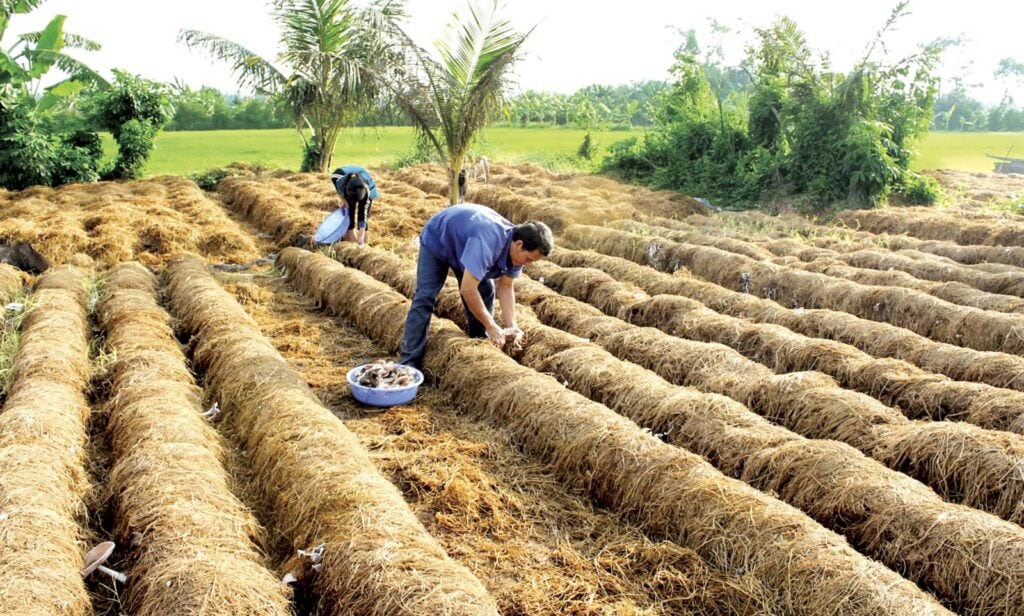
- Using rice straw to grow mushrooms after harvesting the rice.
3.2. Practical effectiveness
From 2017 to the present, Rikolto Organization – a member of the Sustainable Rice Forum (SRP) since 2015 – has supported the implementation of the “SRP Standard Rice Production” model in cooperatives in the Mekong Delta region, including Dong Thap, Kien Giang, and An Giang provinces, covering an area of 4,300 hectares for over 1,500 farmers.
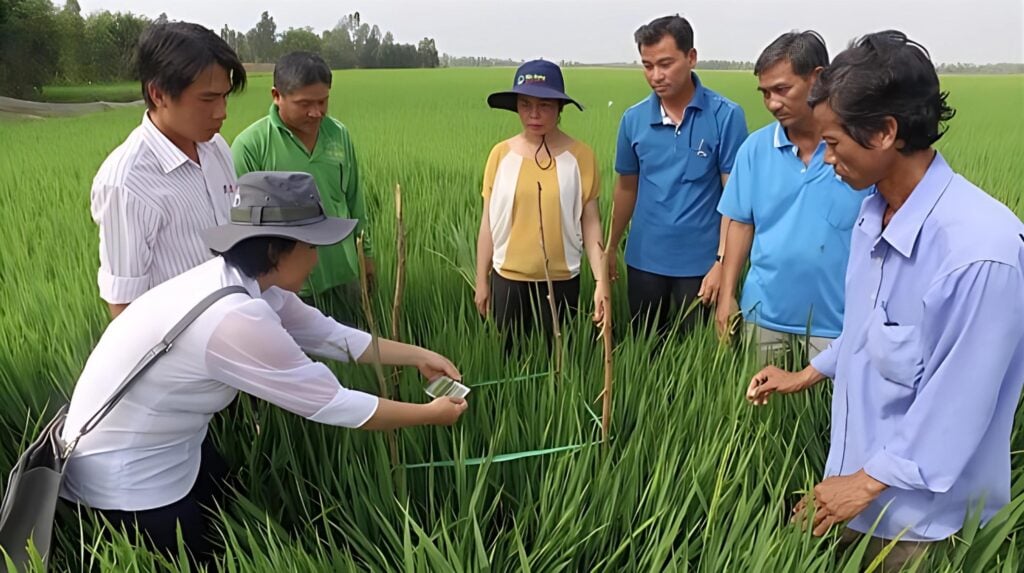
- The SRP (Sustainable Rice Production) standards help the Vietnamese rice industry develop sustainably.
To date, over 97% of farmers participating in the rice cultivation model according to the SRP standards have achieved scores ranging from 80-89 points. 100% of farmers in Dong Thap and 92.5% in Kien Giang achieved over 80 SRP points in the 2021 winter-spring crop. The cultivated area achieving scores from 80-89 points also reached nearly 90%.
Mr. Ngo Thanh Hung, Head of the Rural Development Sub-Department of Dong Thap province, shared: “In production according to SRP standards, it is necessary to combine chemical and organic fertilizers, and management must apply the IPM process, applying the ‘four correct’ principles in production. This will reduce pesticide residue, increase production value, and contribute to protecting consumer health. After about 3 years of implementation, a reassessment shows that fields grown according to SRP standards reduce costs by over 2 million VND/ha.”
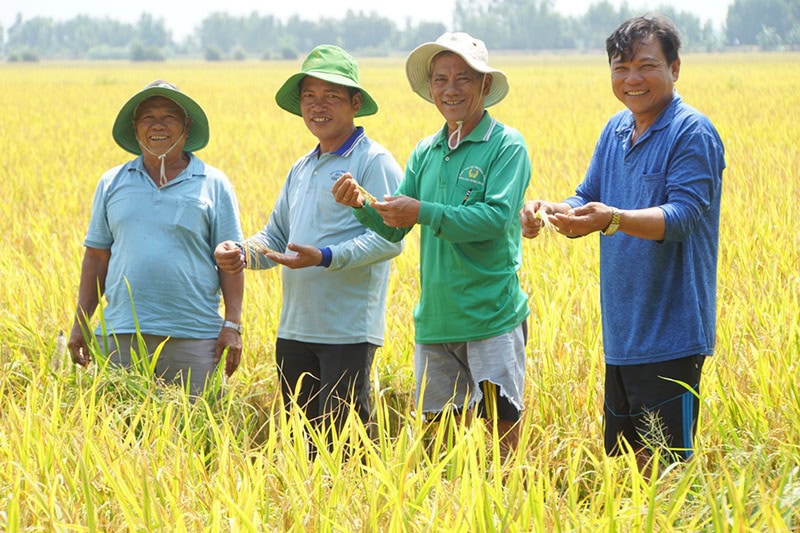
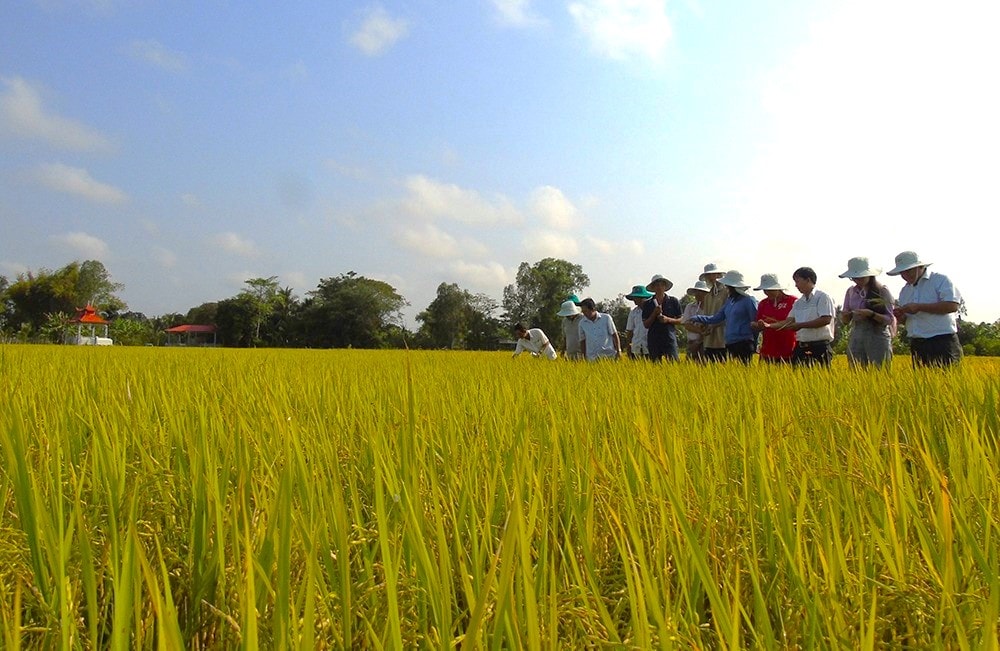
- Visiting a rice field that produces rice according to SRP standards.
During the 2023 summer-autumn crop season, Mr. Tran Van Hoi (Thap Muoi district, Dong Thap province), one of the farmers participating in the pilot program for sustainable rice production (SRP), achieved a profit increase of over 30% compared to traditional rice farming methods after cultivating the OM18 rice variety on 6 hectares. Thanks to adhering to sparse sowing and balanced fertilization practices, pest damage was minimized, resulting in significantly increased income.
According to Mr. Hoi’s calculations, previously, after deducting all expenses, he earned a profit of about 3 million VND per hectare of rice. However, with this new farming model, he can earn a profit of over 4.2 million VND per hectare of rice from selling rice, straw, ducks, and carbon certificates. “By applying the SRP farming process, farmers must adhere to record-keeping procedures, apply fertilizers and pesticides at the correct dosages, and especially commit to not burning fields to cause environmental pollution.”
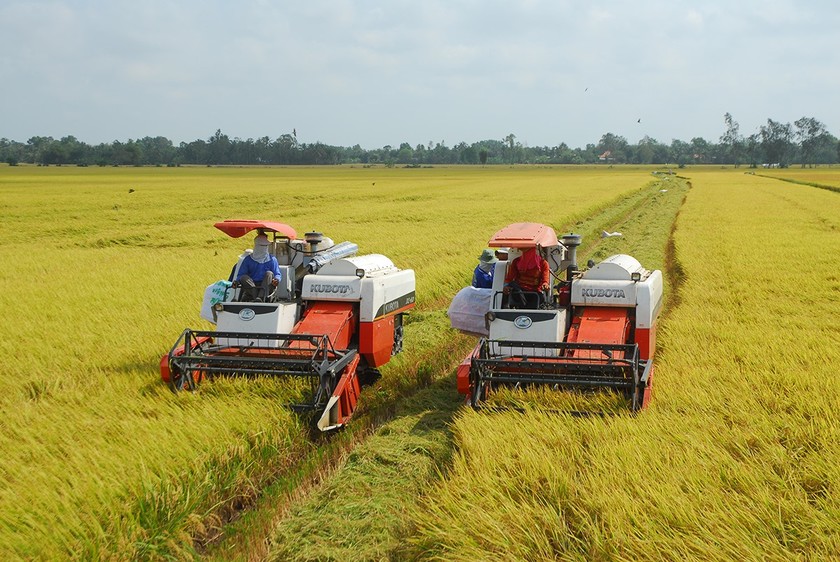
- Rice yields have been increased by applying the SRP standards to farming.
“In terms of productivity, it’s still equivalent to traditional rice farming methods; however, farmers benefit from selling straw, receiving government support for selling carbon credits, and money from selling ducks. Thus, from these profits, farmers can earn an additional approximately 1.2 million VND/ha,” Mr. Hoi said.
Agricultural experts believe that participating in rice production according to SRP standards will be a great opportunity for Vietnamese rice to expand its reach in the global market. At the same time, it will also create favorable conditions for Vietnamese rice to access modern and advanced production methods and connect with leading rice partners.
Conclusion
The above information concerns the Sustainable Rice Production Standard (SRP). Applying this model not only reduces production costs and increases profits for farmers, but also changes perceptions and production practices, contributing to environmental protection and ensuring the health of producers and consumers.
With the goal of developing sustainable rice-growing areas in the Mekong Delta, enhancing the value chain, and protecting the environment, the 1 million hectare high-quality rice project has been launched and is being implemented in many provinces of the Mekong Delta. This SRP (Sustainable Rice Production) standard will be one of the solutions to help farmers build a rice production chain that reduces production costs, reduces emissions, improves economic efficiency, and protects the ecological environment.
Related news
The Role of Base Fertilization in Soil Improvement and Enhancing Agricultural Fertility
Measures to Improve and Treat Saline Soil
Winter-Spring rice blast warning – Don’t let leaf and flower burns rob you of your golden crop

Rice Sowing Techniques for the Early Winter–Spring Crop
What Is Slow-Release Fertilizer? Learn How to Use It Effectively